

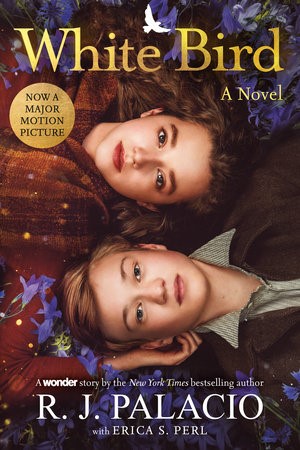
The initial thing for Christian parents to know about here is an interesting one. The heavy and sad Holocaust setting of this book makes it really hard as a Christian to see the author’s seemingly very intentional move away from faith and God. The VERY worst comment, speaking of a pastor, is “I think as a man of faith he finds it difficult to reconcile what is going on around us with his belief in a just and compassionate God… Pastor Luc seems to believe that before things get worse, God will come to his senses and intervene… I told him, with all due respect, we cannot wait for miracles. Evil will only be stopped when good people decide to put an end to it. It’s our fight, not God’s “. This is the type of comment that will be applauded by the secular world (see external reviews below), but we as Christians will know to be so incredibly sad and misguided and dangerous. A lie with a kernel of truth.
There is more of this intentionally non-religious content. Sara, the main character, says that she never heard her father pray, saying he is a “man of science, not religion” (a common and TOTALLY false dichotomy and a very harmful message to children). Despite being Jewish, Sara makes it a point to say their family doesn’t go to the temple and are not religious. At one extremely dangerous moment Sara says, “I had not been raised in a religious household, but if ever there was a time for prayer, this was it” (such a picture of our times, telling God to leave us alone to do whatever we want and then yelling out to him and even blaming Him when in trouble). At another moment she closes her eyes to plead for her friend, but the book refers to it as “wishing”. Later we hear that she “thought, wished and prayed” when helpless. She also comments that she, “closed my eyes and put all of my wishes and prayers – indeed, my very soul – on the wings of that small white bird”. At one point Sara says that “I knew from my dream I would never see my beautiful Maman again” (a spiritual sounding strange comment to put in front of children). After an absolutely incredible event we hear, “you were so lucky”. She sees a small bird as a sign and an omen. Where a Christian book would have Bible verses instead we see confusing lines of poetry.
Things get really odd (and pseudo-spiritual) when the book out-of-nowhere has Sara almost inhabit a bird and flying off, where she sees what is happening far off. This continues when at the death of a main character, with no hope of Heaven to offer, we hear that “it was as if his soul rose up, free of his body and all his earthly limitations, and took flight. Free as a bird”. To make this even worse, the end of the book clearly suggests that after his character this has somehow “become” a bird (“Look, there’s that bird again… I already knew he was there with me. He always was” - this comes up again in the epilogue.
Parents should be aware that this is an emotional and heavy story. It stays heavy nearly the entire time. There are intense parts as well. It won’t be for everyone. A man helping hide Jewish children is shot in cold blood (some detail is given). Children are taken and captured (we hear “no one ever saw them again”). Sara’s mother dies in Auschwitz. A boy who is crippled is lifted up and punched in the face by a larger boy multiple times (we are told blood spills everywhere). A wolf attacks a wicked young man, biting him by the throat. There is also a comment about countless people being murdered by the Germans, including 6 million Jewish casualties. In the middle of a list of glossary terms we see an entry for “The Beast of Gevaudan” who the author tells us was reported to be “a man eating beast” people said was responsible for killing 100 people, including children (she says this inspired her wolf from the story - could frighten some).
This book attempts to weave in a bit of a love story in the midst (a bit of an odd mix of content with everything above honestly). Christian parents need to know that during the budding romance between Sara and Vincint, the other main character, the two young people spend hours and hours alone and unsupervised, typically at night. Eventually they start having minor, but intentional physical interaction (sitting with backs together, letting legs touch, etc.). She begins journaling and sketching constantly about him, mentioning falling in love. Finally a lot of attention gets put on a first kiss, mentioning it as being a very long kiss.
The last major item to bring up… many Christian parents will want to know that in the Epilogue is used in a way that will surprise many. We see Julian’s grandmother reading the paper frustrated. She sees instances citing injustice and prejudice (refugees are mentioned). Many will see at least a light tie being made between the Holocaust and how countries handle refugees (note that the earlier graphic novel version is even more concerning here, even mentioning a Trump policy… see that review on our site as well. Seems to have been lightened a bit here, probably due to feedback). We should mention that we end with her feeling better because she sees the bird that is supposed to be the character who passed away, somehow allowing her to see on the other side of the world her grandson at a peace march.
Other items to be aware of:
Grandma pours herself a glass of wine.
Gossip is listed in a somewhat positive light along with laughing and playing as activities to do with friends.
Main character zones out and draws during math class, justifying her behavior saying, “I couldn’t help it”. Her father asks her to wear boots to school, to which she agrees, but then changes the second he is out of sight.
We see the following terms used: jerk, cripple (in a derogatory way), stupid, idiot. We hear of a “fortune teller”. One person says, “Damn the Nazis to hell”.
Some may care that a note at the very end of the book indicates this was written by the “with” author listed above based on the graphic novel written by the main author listed (see our review on that title as well).