

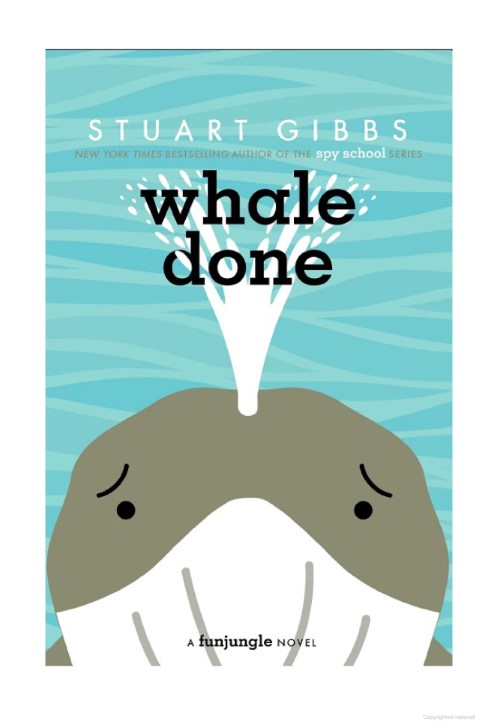
The first important point to bring up concerns the cover. The newest versions of the book covers for this series have bright cute drawings of cartoonish animals. While these books are not targeting young adults, they are also equally not appropriate for the ages that most parents would likely initially assume from the picture alone. Read the rest of this section and then take a look back at the cover and you will see what we mean. This is another solid application of the classic line to not judge a book by its cover. ----
The bigger point of consideration centers around the main message of this book and series: environmental concerns. This is a neat mystery story told in an interesting setting, but woven in is frequent and sizable dialog bringing up many different environmental concerns. If this had been a comment or two that came up once or twice in the book instead of what feels like dozens of multi-paragraph dialog sessions it wouldn’t appear here. As is… well see the discussion below in “Our Thoughts” for more. No matter what, any single topic that comes as a barrage of this size is something parents should certainly consider when deciding whether or not this book is right for their child (along with everything else in this section). ----
Given the subject-matter, there is less focus on evolution than you might expect, but it is still here. The main item comes when a knowledgeable scientist points out two aspects of a whale’s body he says are signs they evolved from land animals. Later there are several instances of discussion about certain animals being closer relatives to humans than others. ----
The head elephant trainer is a woman who at one point is comforted by ‘her wife’. Later a surfer is living out of her van with someone she describes as her girlfriend (which has a different context today than it likely would have in the past). ----
The police are unfortunately shown in a completely negative light. They are rude and won’t listen to the kids or adults. This leads to a feeling that culminates in the comment, “So the police aren’t going to be any help.” While we need to make sure our children know that police are humans in a broken world, we would be wrong to let their view of those who keep us safe on a daily basis be seen in any type of overall negative light. There is also a short, but intense railing against economic injustice you would want to make sure your child understands in context. ----
When the boys meet a model there is a very unfortunate comment that his best friend has all of her ads taped up in his locker. The main two characters are dating, which while not necessarily negative, may or may not be something you want your kid further exposed to if they are younger. There is a mention of two “bikini-clad women” in passing. The main character’s girlfriend kisses a famous person she meets on the cheek and says it is no big deal. ----
Much of the concerning comments in this book come from the uber-rich and shallow characters that live in Malibu. In fact, it is probably not going too far to say that this book is bordering on stereotyping extremely wealthy people (although in fairness one of the main families is wealthy and is held up as an exception). The favorite sport is described as “gossip”. Marriage doesn’t come across in a positive light here. There is mention of marrying someone for money that is much older. There are ugly divorces where cheating and going after the former spouse’s property is referenced multiple times. One character mentions that they don’t expect a new wife to last any longer than the last 6 or 7. There is advice to take some action “in case the marriage doesn’t work out”. There is a large focus on superficial things like mansions, clothes and jewelry. At one point someone says you don’t need school if you are really beautiful. These same characters drink quite often at all different hours and are shown to get drunk at times (one comment around being “pretty wasted” and “puking” 10 times after a party, also uses “tipsy” and “drunk”). Again, this is almost exclusively held in a negative light that the main characters mostly (but not completely) avoid, but it is good to know it is there. ----
The surfer crew (surf rats) is another interesting (potentially stereotyped) case. One surfer gives another “the finger” for cutting her off and yells out names (presumably curse words). She lives out of her van and doesn’t work (outside of odd jobs to buy ramen noodles and gas) so she can surf all day. She punches a rude man in the nose and leaves the scene to avoid the police. “Stoners” are mentioned. Uses the term “rock star” parking (terminology all parents should probably look to avoid). ----
The main character typically doesn’t provide the best example for our kids to emulate. He says, “I didn’t even consider lying to (his mom). Mom could always tell” (implying he would have if that wasn’t the case). Later he says, “if the kid hadn’t been such a jerk to us, I might have felt bad for him”. Lies to his parents for most of the book in order to not worry them. He is jealous and lies to his girlfriend during an argument. ----
Other content to be aware of: When the A/C goes out the kids hear “the profanity begin” including a man who makes “a few shocking suggestions about what (he) could do with the crummy A/Cs”. Several other cases of lying (e.g., to a suspect to get info). There is some “gross” content around a whale that explodes (talk of parts and decaying and such). The following terms are used many times: idiot, moron, jerk. Also, one mention of the following: torture devices, “real piece of work”. There is an exchange that is meant to be funny where a sushi dish is revealed to be “sex organs of an echinoderm”. The boy later asks to ensure he doesn’t eat any more “urchin gonads” or “sea slug turds”.