
The primary concern in this book has to do with its darker content. The characters interact with the dead and are even able to bring them back to life. Eventually a whole multi-generation family of ghosts are encountered. The dead (especially before coming back via the book) are shown to be in a ghost-like state. At one point the main character drifts off and sees her mother, who passed away, in this state. She says, “Oh mother, you’re still in the land of death and I in the land of the living. How lonely we both are.” to which her mom replies “It doesn’t have to be that way. The Book of Dreams. Find the key. Open the gate. Then maybe we can be together again”. Later she has another similar encounter and asks “Are you a ghost mother? Or can you hold me?” to which mom replies “I can do everything except hold you”. These and similar described scenes feel “haunting”. Probably the worst instance of this comes when one of the poems from this dark book that appears in-between chapters says, “Is there no way through the gate (i.e., the entry to the land of the dead)? Or should the living become dead?”. This could obviously be interpreted in a very dark and dangerous way. — There is also a decent amount of less desirable dialog. In one instance it says that Dad cursed as he had never cursed before and another where he tells the kids not to tell mom something that he plans to do. The main girl character says she hates all of the neighbors (who are ignoring her mother’s need for help). There is a comment that “there are so many ways to die in a normal kitchen”. Random instances of “Good Lord!”, devil, happy hour, dreadful woman, horrid girl, looked rather like a dead clown, pillage, strong rum, rather stupid girl, picked by the fates at random, ass (donkey), big fat liar, etc. A woman says she wants to throw herself out of the window (exaggerating about how much she dislikes decor). Later the young boy sees a life-sized portrait of the same woman and she is nude except for a pink feather boa that “covered all of the essential areas”. There is a mention of a cigarette/smoking. The book uses the terms ghosts, spirits, the reborn, etc. A man recalls helping a friend cheat on a test and justifies it. Marriage is shown in a non-Christian light when a king and his wife “get bored of each other”. — Nothing points to a solid understanding of God. At one point the comment is made that “‘we say someone lacks a moral compass’ as if God or whoever forgot to put it into certain people”. God’s name is used in a slightly irreverent way (“God help any…” and “God only knows…” when not really meaning to acknowledge the one true God). Similar use of the devil and hell (e.g., “all hell breaking loose”, “how the hell did you get in here” and “what the hell is going on”). — It mentions the bad guy has a torture chamber so far underground no one can hear you scream. The use of torture is mentioned several times, but never in detail. A man is shot and it describes blood trickling from his mouth. — The main characters, a brother and sister, are mostly solid, but do have multiple moments that are never really addressed to show the behavior as wrong. The sister loses her temper and attacks a “horrid girl”. In a similar moment one of the main characters says they want to fly at someone and rip his smug face open. The brother seemingly joins a group of young assassins because a girl who has caught his eye is paying attention to him. To name a few… — The bad guy in the story is a terrible tyrant. This leads to a lot of dialog that circles around him really needing to die for the good of the nation. At one point a character says that murder is almost always wrong, but killing of a dictator could be justified in the most extreme cases. There is another point where the question is asked if killing him is the right thing, to which the response comes that allowing him to kill others is worse. This is obviously a heavy topic for children, especially Christian children who are called to pray for our enemies and bless those who persecute us.

Psalm 101:3
Quick Answer: Avoid
Concern Level: Medium-High
The primary concern in this book has to do with its darker content. The characters interact with the dead and are even able to bring them back to lif... → Continue reading below
The Book of Stolen Dreams
VERDICT: Avoid
Concern Level: Medium-High
Christian Parent Review
This book is of a type that can prove really tricky for parents, and one that keeps us motivated to keep reviewing. You start reading and think you understand what type of book it is… and then a decent way through the book an unexpected, seemingly out-of-place, element of darkness is revealed. All of a sudden we find out this story of a girl and her brother is actually going to revolve around a mysterious book that is used to allow you to communicate with the dead, who are presented to be in a hazy post-death state that in no way resembles the Heaven & Hell of the Bible. Next we find the book can actually bring these people back to life forever. Even worse, the poems that are shown in-between the chapters have that strange, eerie, dark feel that comes with this type of content. As interesting as the story could have been without this material, we Christians are called to avoid such things and teach our children to do the same. There is plenty more we could say about the characters, the adventure, the solid writing, the ending, but none of it overshadows this overarching concern (plus all of the other concerning content above). Better to find another option without this dark content.
Note: This information is typically from the publisher.
Use with caution
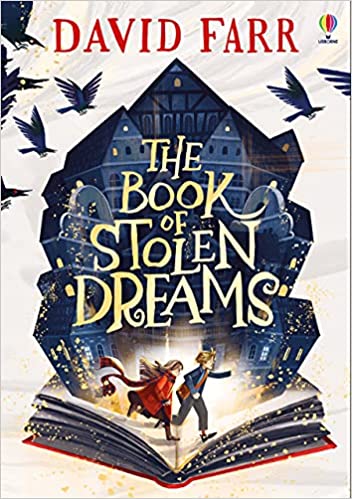
An exhilarating, awe-inspiring debut from a master storyteller writing for children for the first time, perfect for fans of Philip Pullman, Katherine Rundell and Eva Ibbotson. --- Rachel and Robert live a grey, dreary life under the rule of cruel Charles Malstain. But when their librarian father enlists their help to steal a forbidden book, they are plunged into adventure. With their father captured, it is up to Rachel and Robert to uncover the secrets of the Book of Stolen Dreams and track down its mysteriously missing final page in order to save him. - What they are not expecting is to discover a family of ghosts, a door to the dead and that the Book grants the power of immortality. But they will do anything to stop it falling into Malstain's hands - for if it does, he could rule for ever. - Step inside the pages of an immortal adventure and discover a truly unforgettable journey of wonder, courage and magic...
Above Reproach: We intentionally do NOT use referral links on this site.
No purchase convenience link provided for 'Avoid' books
Other Reviews for this Book
Kirkus Books
A short secular view of the book.
A good example of why Christians need Christian review sources.
Read ReviewScripture Reflection
Trust in the Lord with all your heart and lean not on your own understanding; in all your ways submit to him, and he will make your paths straight. Do not be wise in your own eyes; fear the Lord and shun evil. This will bring health to your body and nourishment to your bones.
— Proverbs 3:5-8
--- See More Christian Parent Reviews ---
More Christian Parent Reviews