

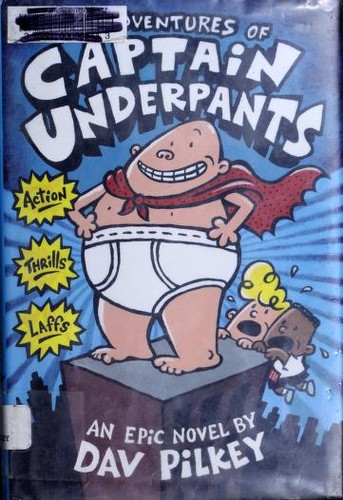
For discerning Christian parents, a really revealing moment comes right up front in this one. While it is meant to be funny, we think it does show the heart of what we are dealing with. The author tells us that “George and Herold were usually responsible kids” (we begin to think, “well, that’s good). This is immediately followed by a joke revealing that this means, “Whenever anything happened George and Herold were usually responsible”, while showing them standing in front of a flower shop sign they have changed from “Pick your own roses” to “Pick our noses!”. Vandalism aside, it’s the author’s next addition that is really unfortunate. We are told, “But don’t get the wrong idea about these two. George and Herold were actually very nice boys… they were good, sweet, lovable… Well, ok, maybe they weren’t sweet and lovable, but they were good none the less”. We will see this is not a fluke, but actually the focus of the boy’s lives and this book. The author goes on to call this all a “silly streak”. We would call it something much different.
The first story we are told then begins with, “After a hard day of cracking jokes, pulling pranks, and causing mayhem at school…”. We then see a cover-to-cover glorifying of this type of behavior.
A few specific things that stuck out:
- A solution is said to involve “a little blackmail”
- Young readers see lines like, “Luckily for the boys, the secretary was much too busy to keep an eye on the copy machine”.
- We see illustrated a whole span of pranks the boys pull at a football game. The result shows everyone besides the boys completely miserable. Then it pans to the boys laughing hysterically, focusing only on how they can top it next time.
- When called to the principle’s office, the boys decide not to sweat it, “Don’t worry, they can’t prove anything”. This principle is of course made out to be a villain type character.
- It turns out the principle can prove the boys were at fault, thanks to video. What does this responsible adult do? He blackmails them to do his chores and such. So there’s that.
- How do the boys respond? Hypnotism. They order something to hypnotize him to do their bidding (which is of course, a bunch of embarrassing actions).
- When this goes wrong, George tells Herold they have to help because, “He could have been killed out there”. This has zero impact on Herold. So then George follows up with, “Or worse, we could get in big trouble”, which puts Herold into immediate action.
Especially with this being aimed at young readers, especially boys, many parents will want to know that the book is, seemingly intentionally, filled with poor grammar, misspellings, etc. This is ironic given that many parents justify books like this in an effort to get their reluctant readers reading more.