

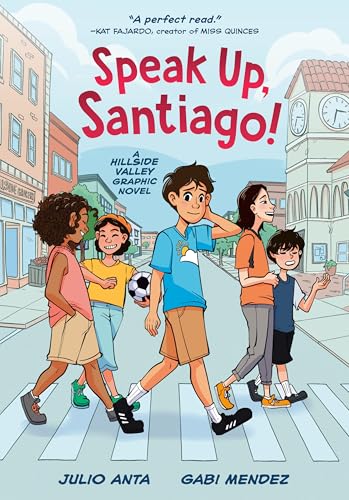
For a big portion of the book Santiago is not a great character. He often gets very negative about learning the language (things like “This is hopeless”). He overhears his grandmother and friends talking about his accent and laughing a bit and Santiago loses it, sending him spiraling down. He starts being rude, disobedient, unkind to everyone. While certainly lessons can be gleaned from this and it is resolved, it is not pleasant at all to read. Especially in the cute and colorful graphic novel format we think this could have been done differently and made the book much more enjoyable.
The illustrator’s bio lists her as “queer”.
On a related note, we see a girl cheering for one of Santiago’s teammates who is also a girl. A small heart is shown, indicating love. While there is no indication if this is romantic or not, most readers will see it that way.
Other things of note:
Early in the story we see Santiago convinced his father doesn’t understand him, but he doesn’t speak up and talk with him.
The older sister of a friend character (who is shown to have a large number of piercings) works at a gas station and has a huge collection of books behind the counter. Readers find she has multiple “banned books”. One series is shown to have “romantic adventures”.
Another sibling is described as “kind of bratty” and later a jerk.
The term “zen” is used in relation to martial arts (e.g., “Your brother needs to find some of that zen he had at the karate studio”).
Grandma tells the story of her father abandoning them and unfortunately says, “frankly, we were better off without my father and his negativity around the house”.
The term jerk is used multiple times.
Please note that this story references a larger set of stories (“a Hillside Valley Graphic Novel”), which we have not yet reviewed. This review is focused on this particular title.