

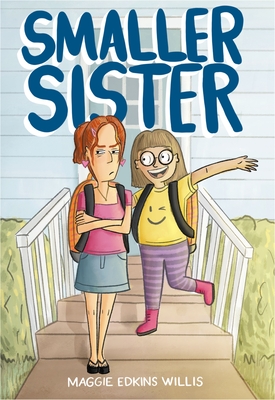
We open the cute and brightly colored cover. If we somehow are not too drawn to the neat illustrations just on the inside of the cover… at the bottom of the page… in small writing… under a long section of ISBNs and similar publisher info… we might just see a content warning. Yes, this bright and colorful graphic novel has a content warning. This warning tells us that the story the young reader is about to embark on has “eating disorder thoughts and behaviors”. We really feel it should have warned about much more, especially given the young kid focused format the author and publisher chose to use to deliver it. The best way to think about this story is seeing someone losing a battle with a terrible drug addiction and the immense pain that causes them and everyone around them, but here the addict is a young teenage girl (the older sister), the addiction is an eating disorder and the damage is seen through the eyes of a very young little sister (oh, and it’s delivered as a graphic novel that you would not except this topic or level of content on looking at the cover). But the intensity, fighting and hurting is much the same.
The intensity of the fights between Olivia (the addict) and her parents are frequent and intense. The incredibly mean and damaging behavior from Olivia to Lucy (the younger sister the story is told through) is also often present. The whole thing takes an emotional toll on an adult reader, let alone a young child. The illustrated format only deepens this. For example, when the parents announce an opportunity that will take them to a new and better school Olivia completely loses it, screaming and being terribly rude and disrespectful, finally shouting, “this is because Lucy doesn’t have any friends, isn’t it?... You’re ruining my life!” and then stomping off angrily.
Even outside of the eating disorder, for most of the book we see the same terrible sibling interaction depicted the world sells as “normal”. Olivia’s friends are really nice to Lucy, but we see that Olivia hates her being around when they are. At one point when she is really sad at school, sitting alone, Olivia’s friends walk over to check on her and we see Olivia sigh and make a rude face, showing she doesn’t care or want to go. When Lucy asks her to hang out like they used to, Olivia is incredibly rude and mean, insulting her ideas for what they could do, eventually hanging up a “keep out” sign. We read the sad comment, “Olivia ignored me for most of that summer”. Mom tries to hug Olivia, who gives her a very mean look and walks off rudely. Later she comments, “Ugh, you’re such a suck-up Lucy”. Olivia is even terrible towards someone she sees on TV (“Doesn’t she look like an elephant?”). This is just a sampling of the angry, rude, mean conversation that feels like it comes over and over, page after page.
While very much a victim, Lucy is certainly no great character either from a moral perspective. She eavesdrops on Olivia and her friends, commenting that, “I learned all the best dirt on my sister that way”. Lucy also shows a lot of jealousy. She calls mom’s dinner “gross” and mom immediately caves, “Ok, fine. Just eat the rice”.
This topic leads to quite a bit of unhealthy focus on appearance (again usually through Olivia’s words and actions, observed by Lucy, with little to no parental wisdom applied… and certainly no focus on things like us being made in the image of God and finding our worth and value in Him). Eventually Lucy turns to worrying about her own body and appearance. There is a point where her friend is talking about boys and then turns to her and says, “Do you ever think about dressing a little older?” At a new school Lucy tries to reinvent herself with new clothes and lies about herself. A girl tries on Lucy’s pants in a locker room and says, “Wow, these are huge. Whose are these?” to which another girl replies, “No shame in a little junk in the trunk, ladies. Boys always tell me my curves make me look Mature. I’m already a c-cup” to which another girl tells Lucy she must be “still waiting on a visit from the boob fairy, huh”. At a sleepover with these girls there is truth or dare, crush gossiping and eventually Lucy hearing them bash her over her looks, clothes, making fun of her birthday gift, etc. After finally getting to a somewhat happy breakthrough with her sister, hoping we may see some positive light in the book, instead we hear of Lucy’s plan to change herself along with a graphic titled “Things I want to change: everything” then “Things I loke about myself: Nothing at all” with associated drawing on herself. Her and a friend start discussing how they want to look like someone else and ways to lose weight (one image shows them trying a spell to do this). At this point Lucy starts spiraling as Olivia had. Olivia offers to help… and then ruins it by promising not to tell her mom.
This is all very heavy. Parents are overwhelmed. Mom is crying. Eventually, through Lucy’s eyes, we see Olivia is anorexic (bulimia is brought up as well). In a very sad turn, the parents start largely ignoring Lucy due to the weight of trying to help Olivia (missing a real opportunity to show this all lovingly through the eyes of wise parents, instead seeing it through the eyes of a young victim, without that wisdom).
One of the most concerning points comes when Lucy reads Olivia’s journal. It starts bad, with Olivia complaining about her parents not letting her buy a pair of pants, but it get much worse. There is a whole page filled with the word “UGLY” and we see this disturbing image. It culminates with a note from her older sister saying “I just want to drink a bottle of poison and fall dead on the floor”. Take a minute and think about that… and make sure to take the graphic novel audience and the colorful cover into account when you do…
Other things to be aware of:
Other characters are shown with negative behavior. Girls on the playground shout, “that’s a baby game” to Lucy’s idea and others make fun of her (“can you even do a pushup?”).
We see Olivia flushing broccoli down the toilet.
There is a drawing of 3 couples kissing. Hard to tell gender on some so young readers may see a non-biblical relationship depicted.
There is a joke about a psychic. We hear a mention of trying to “wish” Olivia better.
Book mentions hormones and period.
We read the comment, “that place looks haunted”. There is a joke about ghosts and a group tells of a previous year’s Halloween where they dressed as “devils”. We hear a name: “eyeshadow zombies”.
A couple of times girls are shown in bra / underwear.
The following terms appear: “ohmigod’, jerks