

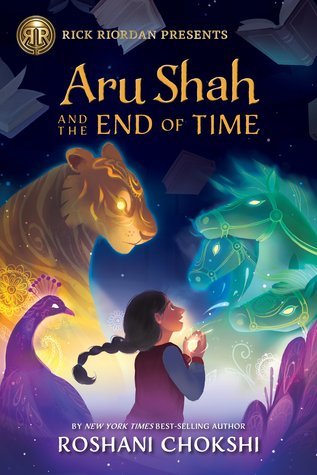
Anyone who has studied Hinduism won’t be surprised that young readers will be presented with a near cover-to-cover smorgasbord of gods and goddesses and related items.
Here are some examples:
At one point a certain set of gods and goddesses “vehicles” are stolen. The reader hears some examples, such as “the elephant-headed god of new beginnings rode a mouse”, “The goddess of luck… rode an owl”, “Indra, the king of the gods, rode a majestic seven-headed horse”.
The “gods” in the item above are just a sampling of the many beings like this that are presented throughout this story.
“But let’s not get into questions of metaphysics. Many things can coexist. Several gods can live in one universe. It’s like fingers on a hand. They’re all different, but still part of one hand”.
There is a “hall of the gods” and statues of some of the Hindu gods.
A strange story is told of someone who was gazed upon and gained super-strength, but the tale continues to say that he would be invincible if he had been naked for this.
“You are siblings because you share divinity”. We read of the girls “soul Dads” (referring to gods)
“You are a child of the gods because one of them helped forge your soul”.
“gods help us” and “gods willing”
On seeing a collection of other beings we read “These Guardians were immortal and worthy of worship, but were often considered separate from the main league of gods and goddesses”.
Aru herself finds out her dad is actually a ‘god’, which makes her realize she must be a reincarnation of a great warrior.
A quest is made to the “Kingdom of Death” with multiple demons (one with a really creepy description)
We are told that poison was released when the gods “churned the ocean of milk”
Where this really ramps up is when the author starts to weave in the themes of reincarnation (gods, people, animals) and karma. These, especially reincarnation, comes up over and over to kids reading the book as the story progresses and is presented as if it was a reality of our world.
Examples:
It mentions some of the Hindu gods “didn’t stay as one person all the time. Sometimes they are reincarnated– their souls were reincarnated in someone else”, to which Aru applies to herself and her life.
A chapter is titled “I’ll be a cow in my next life”
“Aura” is referenced
“But he was alive thousands of years ago” to the reply came “so were you” (referring to past lives)
Refers to “one of the reincarnations of the gods”
A book has a title of “What to Expect when You’re Reincarnated from a Cockroach”
Describing death: “Your soul could live hundreds – maybe thousands – of lives before you got out of the loop of life and death by achieving enlightenment”.
There is a being who records everything a soul does, relates this to karma.
Aru is told that if she fails in crossing a bridge she will “fall into the fires of hell and be forced into the next life”.
We are told “the ills of our life will follow you into the next” (related to karma)
We read “The soul sheds bodies, just as the body sheds clothes”.
A misleading mistake is brought up that caused a character to “send a good guy to hell and a bad dude to heaven”.
The most concerning set of this is the content that will sound like truth from Christianity mixed in with this false Hinduism. One god is called “the King of Heaven”.
Maybe the very most concerning thing from a Christian perspective is to see over and over God’s glory being given to false beings (e.g., beings responsible for the seasons).
A really concerning comment comes when Aru says, “But not all demons were bad”.
On top of all of this Aru’s dishonesty is a subtheme of the book that unfortunately is handled in a way Christian parents won’t appreciate. She feels like an outcast at her rich school which causes her to lie habitually. She causes her nose to bleed to get out of gym. What makes this so bad are comments that seem to justify this, “But maybe she wasn’t lying as much as it was applying a little imagination. That wasn’t such a bad thing”. On top of this Anu refers to a character being good, honorable and perfect, but then adds “almost to the point of excess”. She also rolls her eyes. At one point in the story she tricks a group of beings by acting like the very bullies that have made her life miserable (seen in a positive light). After reading of her huge lying problem, later we read that she “may fib a little, but she never broke her promises”. Near the end we still see things like this “I’m not a liar… I’ve just got a big imagination” and “I lied. Sometimes I do that. I’ve got a big imagination. I try not to lie about important things though”.
Other things to consider:
Demons are a big part of the story. A cursed lamp awakens a demon whose job it is to summon a wicked god. Unfortunately sometimes these serious topics are presented in a light manner, e.g., “Between a demon that could end the world and a 7th grade girl, Aru (and probably most people) would choose the demon any day”.
Cursing is used multiple times in reference to using foul language (although not listed).
Cursing is used multiple times in terms of cursing someone. There is a cursed lamp. Worst off, near the end we hear “but maybe curses weren’t all terrible.
Buddha and meditating is referenced.
There is a reference to sorceresses, zombies and demon possession.
There are several vague references to “the universe”. Aru says she hopes “the universe would take pity on her”. Others: “The universe has a cruel sense of humor”, “Thanks universe”, “Please tell me the universe feels bad for us”.
When a being sees into deep dark secrets we read from one character “Your brother hides a photo of one of his soccer teammates beneath his pillow… he swore you to secrecy”.
We read: “why God, why me”.
A chapter is titled “Who’s Your Daddy”
We see an offer for a “very good daydream” with Aru noticing it has a winking face next to it
A creepy location has masks of screaming women hanging from the roof and a similar portrait of a woman, again screaming.
A woman who married five different brothers a year at a time is called “virtuous”.
In a list of things Aru is flippantly complaining about with her middle school dance one is leaders saying, “Leave room enough between you and Jesus” and by the end of the night becoming, “Leave room for the Holy Trinity”.
Story is told of a boy in class who gives himself “fake boobs” using tissues.
There is a demon with “blood-splattered jaws”
Shares a wish that includes her having a cigar (seems like a movie reference)
A character is “cursed to lose his manhood”
A girl is referred to as “the school’s best gossip”
“OMG” is used
Aru comments that she “had to admit that being a tattle-tale was the worst thing you could be at school”.
A woman tells Aru, “Don’t go outside without sunscreen or you’ll get darker and won’t find a husband
A character comments that “Between good and power, I will always choose the latter”.
Someone is smoking a cigarette.
A sign reads “Thanks for supporting your local haunting”
At death we hear of people’s last words being “I hope someone clears my Internet Browser”
Aru tells us she takes sips of her mother’s Sunday glasses of wine “just to see why people fussed over the stuff”.
Aru “utters a word that, at school, would have gotten her thrown into detention for a week”.
A being tells a story that begins, “She loved me, so I killed her” (then the how is described)
We read, “and if you’re not vaccinated, you die”
What happens if they come across the villain? “Oh, well. He kills you”.
The term “sister from another mister” is used
There are mentions of the following: Real Housewives of Atlanta, Game of Thrones, Divergent, Buzzfeed, Voldemort, Die Hard, Bollywood, The Dark Knight, Matrix, The Golden Compass, Disney’s Haunted Mansion, Hunger Games.
Note: Please make sure to see the concern raised in the Redeemed Reader link below for the later series as well! (as if there wasn't enough here).