

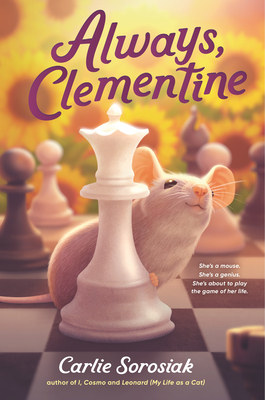
From a moral standpoint, this is a very clean book. That being said, there is one main point we want to highlight. The central theme of the book puts the full weight of all good and wise characters against the (seemingly evil) lab that Clementine, Rosie and Hamlet (the lovable animals of the book) are held in as the book opens. We are told the lab is keeping animals of all types to do scientific experimentation on. The unfolding story has characters researching what happens to animals in labs. This leads to the common children’s story setup where a complex issue gets oversimplified and seen from one side, getting amplified by the fact that in this case the animals are incredibly humanlike (we hear the story through Clemetine the mouse’s eyes) and because some of the presentation is a bit emotionally charged, such as when a news anchor suggests that the scientists will likely take this humanlike sweet mouse and “cut her open and study her brain”. This is further reinforced by an author’s note sharing further detail on her view of sad real-world situations.
Now we are not in any way experts on animal testing done by scientists, but a few things need to be said on both sides. First off, we are called as humans to steward this beautiful creation that God originally declared good (very good when humans we, as steward, were created). Secondly, without even researching it, we can say that we have no doubt that sinful humanity has failed many, many times in this stewardship and that has certainly happened at the hands of scientists and companies working to maximize profit. But the idea that there are situations where science can potentially save human life by doing certain testing on animals first is one that can at a minimum be debated. The Bible clearly points to a difference between humans and animals. Without doubt, it is more nuanced and complex of an issue than to have it fully tackled in a secular children’s book so please take some time to walk a child through this.
A few other minor items we will point out:
The very start of the book can be a bit confusing. Clementine (a mouse) is recording letters to her friend Rosie (an ape), but at first we don’t know anything about them and how they got separated and Clementine isn’t writing the letters, but only dictating them out in her mind. You may need to help explain this.
As a part of describing herself as an optimist, Clementine comments that she believes humans are “mostly good”.
Luck is referenced a few times, such as when Pop calls mice “lucky”.
The following comments are made: “holy smokes”, “could be ghosts”, “well, duh” (not really meant in a rude way)
An older woman exclaims, “we’re gonna give ‘em heck tomorrow. You can bet your… tail on it!”. Later she says, “I would've said something other than ‘good golly’, but I’m led to believe this is a wholesome television program for children”. She also rudely says in passing, “who cares what Marty thinks”.
A bad character randomly remarks, “You can never trust a Canadian”.
A book called “The Witches” is referenced (presumably Ronald Dahl’s book) is brought up, to which a character replies, “I loved that book”.
A chess move is called “Frankensein-Drakula variation”
Clementine wonders if the secular events of the book “are my purpose”.